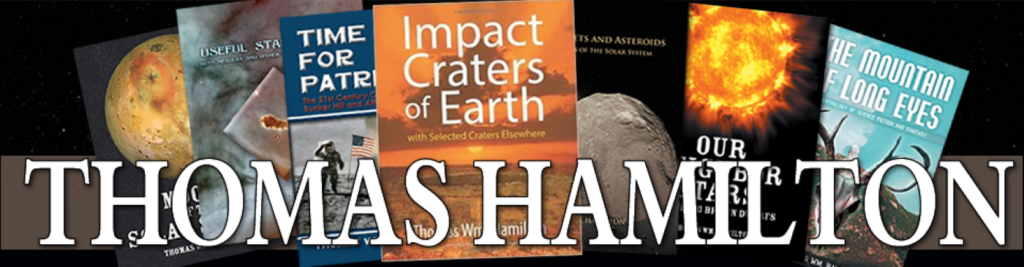
Books by Thomas Wm. Hamilton
- Scam Artists of the Galaxy
- Moons of the Solar System: Revised Second Edition
- Dwarf Planets and Asteroids: Minor Bodies of the Solar System
- Time for Patriots: The 21st Century Confronts Bunker Hill And After!
- Useful Star Names: With Nebulas and other Celestial Features
- Our Neighbor Stars: Including Brown Dwarfs
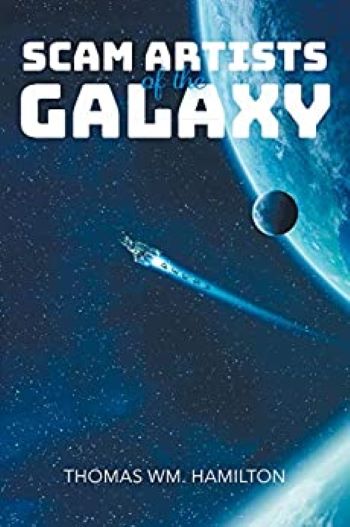
Scam Artists of the Galaxy
Scam Artists of the Galaxy features a pair of creative scammers who travel from planet to planet 450 years from now. Their misadventures cover a wide variety of scams in nineteen widespread locales.
On some planets the male cousins make money, while on others they leave one step ahead of the local equivalent to a sheriff. One of them, a ladies’ man, even tries to pick up girls at every space port.
Their tricks include fake artifacts, insurance fraud, complex currency tricks, a missing heiress, gambling, fraudulent psychological aids, and even a supercilious cat.
Several stories strongly reflect the author’s astronomical background, who was motivated to write the book after considering all the boring phone and email scams he receives. Wouldn’t scammers be more intelligent in the future, he thought. “I think mine are more creative than the ones I get. Felt sorry I didn’t add a couple more scams.”
ISBN:
978-1951530266
ISBN-10 :
1951530268
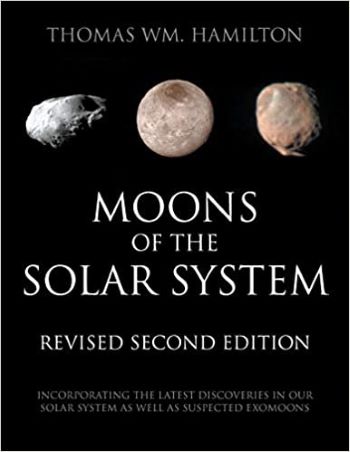
Moons of the Solar System: Revised Second Edition
Retired astronomer Thomas Wm. Hamilton has written six books on astronomy. But science always changes. His most recent book, Moons of the Solar System, has just been revised to incorporate the newest research and information on these amazing bodies in the sky. The new title is Moons of the Solar System, Revised Second Edition: Incorporating the Latest Discoveries in Our Solar System as well as Suspected Exomoons.
Having once worked on the Apollo Project, the author has long been fascinated in studying moons. From Galileo’s discoveries in 1610, to the latest returns from the Cassini spacecraft in orbit around Saturn, four centuries of discoveries in the solar system are summarized, complete with the names of those responsible for finding them.
The 185 known moons of the planets and dwarf planets in the solar system are described in great detail, from how they were discovered, and by whom, to information about their sizes and orbits.
The strange and exotic origins of the moons’ names make for astonishing stories. Moons of the Solar System also includes the possible dangers faced by human travel in space.
ISBN:
978-1949483222
ISBN-10 :
1949483223
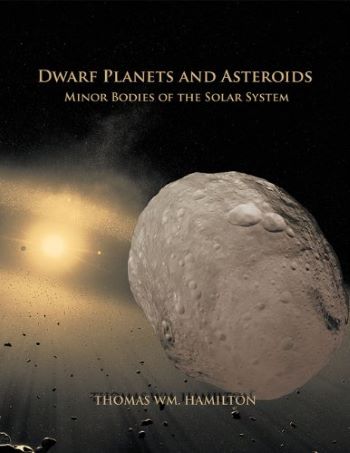
Dwarf Planets and Asteroids: Minor Bodies of the Solar System
This stunning astronomy book explores Dwarf Planets and Asteroids: Minor Bodies of the Solar System.
Written by a retired astronomer, the book provides a survey of the dwarf planets and asteroids, giving details of the discovery, naming, orbits, and physical characteristics of hundreds of examples of the known asteroids found by astronomers in the past two centuries. It also includes the different groups and classes of asteroids.
Those bodies that have been visited by spacecraft are singled out for extra attention, including close-up photos where available. About two hundred asteroids have been found to have moons of their own, and the story of their discovery and examples of these moons are also included.
ISBN:
978-1628577280
ISBN-10 :
1628577282

Time for Patriots: The 21st Century Confronts Bunker Hill And After!
“Time for Patriots is a delightful adventure with marvelously crafted characters so realistic I could swear I knew them.”
Guillermo Alfonso Calvo Mahé, Professor of English and Political Science, International Relations Directorate, Universidad Autònoma de Manizales.
“Time for Patriots is a fascinating look into a world changed by knowledge from the future.”
Christopher Nuttall, Producer and Managing Editor of Changing the Times, the online Alternate History magazine. (www.changingthetimes.net)
“Time for Patriots is a splendid first novel by an author — already a serious scientist — who has the potential to be a most formidable sci-fi author. It is a highly imaginative story which reveals both a grasp of science and of history.”
Bernard J. Sussman, Lawyer & Librarian
ISBN:
978-1606932247
ISBN-10 :
1606932241
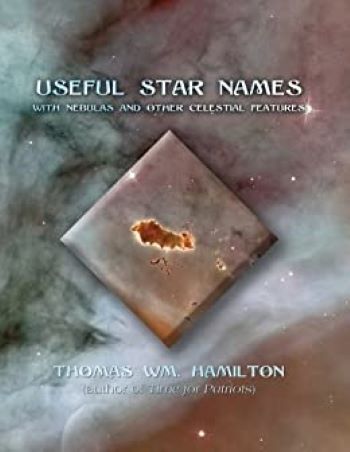
Useful Star Names: With Nebulas and other Celestial Features
Travel the universe when you open the breathtaking new book Useful Star Names: With Nebulas and other Celestial Features.
Retired astronomy professor Thomas Wm. Hamilton invites you along as he provides an alphabetical listing of the 88 constellations. Learn the names of the stars, nebulas, and galaxies within each, as well as how to find their location in the sky and their brightness.
Learning the stars is more personal when the stars have names. Professor Hamilton says his students always preferred to learn a star by its name, rather than by its catalog number. “Teegarden’s Star is so much nicer sounding than SO 0255790.5.”
Cover Photograph: Caterpillar Nebula, in the constellation of Carina, photographed by the Hubble Space Telescope, courtesy of the Space Telescope Science Institute, Baltimore, MD 21218
ISBN:
978-1612046143
ISBN-10 :
1612046142
Our Neighbor Stars: Including Brown Dwarfs
The sky’s the limit in the fascinating book Our Neighbor Stars: Including Brown Dwarfs. The book presents all known information on the 100 stars nearest Earth, as well as the brown dwarfs within the range covered by these stars.
Learn where (and whether) the stars are visible in the sky, who discovered them and how they were discovered. Read all about the stars’ sizes, colors, presence of any planets, and the constellations where the stars are located.
All the information is indexed, so particular types of stars can be easily found.
ISBN:
978-1618971326
ISBN-10 :
1618971328
The Mountain of Long Eyes : An Anthology of Science Fiction and Fantasy
About 500 years pass between the first story and the last in The Mountain of Long Eyes: An Anthology of Science Fiction and Fantasy. This wonderful collection of science fiction and fantasy stories range from a Native American shaman using magic to battle modern-day terrorists in “Mountain of Long Eyes,” to space opera mysteries in distant galaxies in the story “Beyond Space.”
A character playing a prime role in two of the stories is a woman who flees a planet ruled by a repressive theocracy as a teenager in “Crime and Consequences.” Her adult story is told in “Beyond Space.”
There is humor and social criticism in “Why My Mother Hates Me,” and there is horror in “The Seat of Learning” and the vampire story “Red Blood.” A president may or may not have stopped an attempted coup in “Viewpoints.” It is left for the reader to decide. An assault across alternate universes takes place in one tale, and there’s even a ghost story in “Why I Must Move.”
The collection is well balanced with humor, politics, horror, space opera, alternate history and time travel.
ISBN:
978-1622120284
ISBN-10 :
1622120280

Impact Craters of Earth: with Selected Craters Elsewhere
Craters have been found on planets and moons throughout the solar system, caused when asteroids or meteors have collided with them. Our Earth has not escaped these impacts, and nearly 200 craters are known on Earth today. Some are easily visited, others are in locations few would ever want to get near.
This book details all the known terrestrial impact craters, telling their age, size, and other details, as well as highlighting those easily visited. One has an annual “Crater fest” to attract tourists, while it is possible to swim in lakes that have filled others.
ISBN:
978-1631353536
ISBN-10 :
1631353535
Astronomical Numbers
Thomas Wm. Hamilton’s latest book Astronomical Numbers provides most of the commonly referenced and used numbers in astronomy.
This includes the diameters of the sun, all the planets, and major moons, distances of orbits, magnitude scales, frequency of eclipses, the five different kinds of lunar month, and more.
To maximize usefulness, all values are in both English units (e.g. miles) and metric (e.g. kilometers), and provide conversions for units commonly used in astronomy, such as the astronomical unit, lightyear, and parsec.
Says the author, “There is a real need for a convenient and quick reference for all this astronomical data, which is scattered and time consuming to find.”
ISBN:
978-1681814902
ISBN-10 :
1681814900

Weird Thoughts
Seventeen short stories are featured in Thomas Wm. Hamilton’s latest book Weird Thoughts. Spanning the years 1912 to fifty million years in the future, the book’s genres cover science fiction, fantasy, and satire.
The stories are followed by seven essays in the field of astronomy, including issues that can be easily misunderstood by the general public. The author was previously an astronomy professor who worked three years on the Apollo Project, determining orbital characteristics, fuel usage, and radar accuracy requirements for space travel. This experience is described in one of the astronomy essays in the book.
Three stories set in the far future describe wars taking place among highly evolved animals, including intelligent monkeys, raccoons, dogs, cats, and dolphins.
One tale describes an alternate world in which a murder victim gains justice in a time travel adventure. The U.S. presidency is at stake!
In other stories, teenagers discover the importance of Spell Check while doing magic, and then there’s the tale about Halley’s Comet.
ISBN:
978-1946540775
ISBN-10 :
1946540773
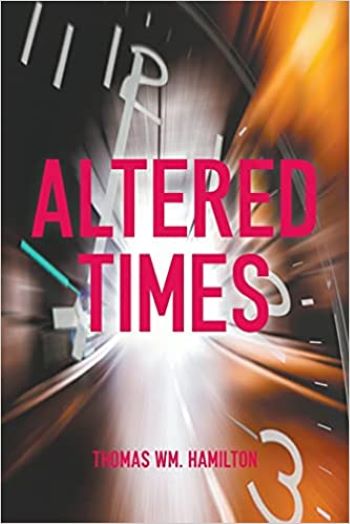
Altered Times
What if?
Altered Times is a stunning collection of short stories that examine the consequences of a single change in history.
The stories look at how a number of events may have gone in a different direction, from the decidedly pre-historical collision of Earth with the astronomically theoretical proto-planet Theia, to three alternative consequences for the 2020 presidential election. In between, Caesar pays attention to the soothsayer, Aaron Burr’s gun misfires, and other events change the world as we know it.
The earliest story tells when Theia and Earth fail to collide 4.2 billion years ago, resulting in our moon never existing. Imagine if Caesar does beware the Ides of March, if Alexander Hamilton never dies in a duel, if James Marshall quietly collects gold instead of riding his horse into town screaming, “Gold! Gold on the American River,” setting off the California Gold Rush.
What if the January 1912 murder of a California assemblyman is averted, resulting in his election as president in 1940? And what could have possibly changed the 2020 election?
What if?
ISBN:
978-1682354735
ISBN-10 :
1682354733

Election Matters: Life on Universityworld
As a 15-year-old, Parvin escaped her home planet of God’s Victorious Warriors, when its repressive government executed the rest of her family.
Now living on the planet University world, the former runaway teaches mathematics and is known as Professor Parvin Priddlikachorn. Her husband, Professor Siddithamon Priddikachorn, nicknamed Pretty, teaches planetary geology and hails from the planet Pradang. The couple have a 17-year-old son and 14-year-old daughter.
Parvin thinks the time is right to run for office, so she seeks a seat in the third house of a four-house planetary legislature. Her son and his girlfriend help with her campaign, but Pretty tries to discourage his wife’s political ambitions.
It happens that Parvin’s home world has a long-standing order of execution out on her. University world is harboring a covert cell of its assassins, The Righteous Fists of God, which is headed by an officer in their planet’s secret police. One of its crew, Neto, is enrolled as a student, but unknown to everyone is that his professor is the subject of their search.
Meanwhile, a controversial figure hopes to win control of the fourth house.
ISBN:
978-1682355862
ISBN-10 :
1682355861